
 Mold
Black spots in a bedroom corner, behind the dresser or at the back of a closet are among the most common winter calls we get. Here is why mould grows on walls in GTA homes, how to tell it from dirt, what you can safely clean yourself, and when it needs a professional.
In This Article
Mould on a wall is a moisture problem first
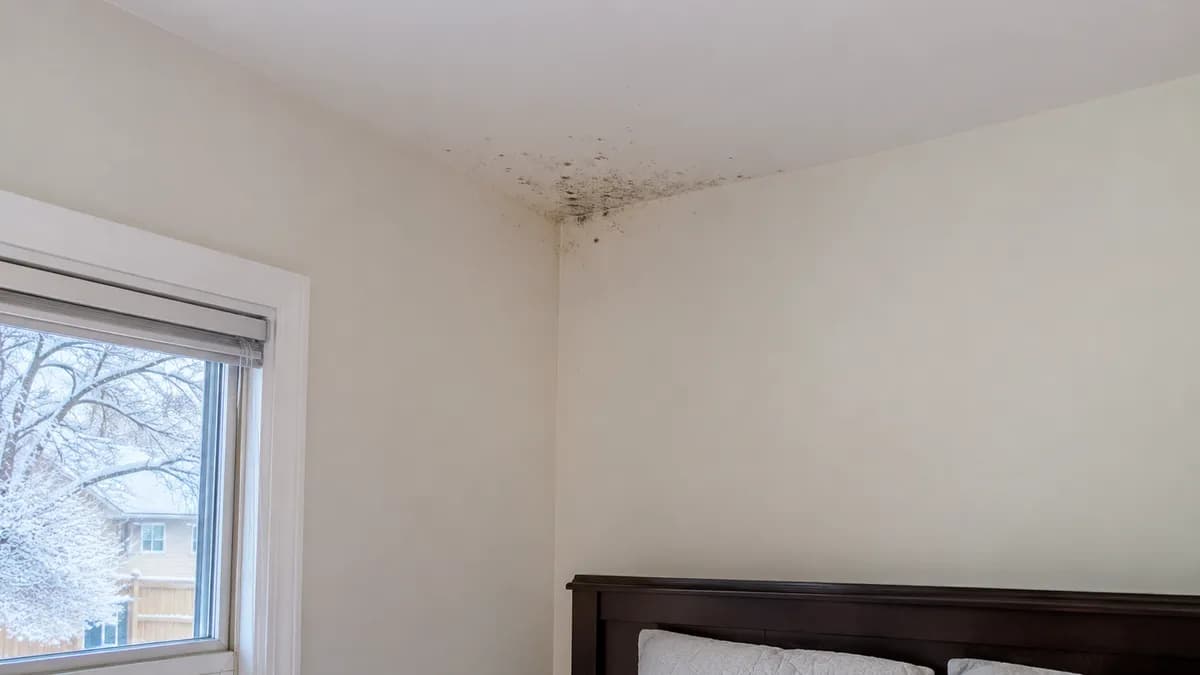
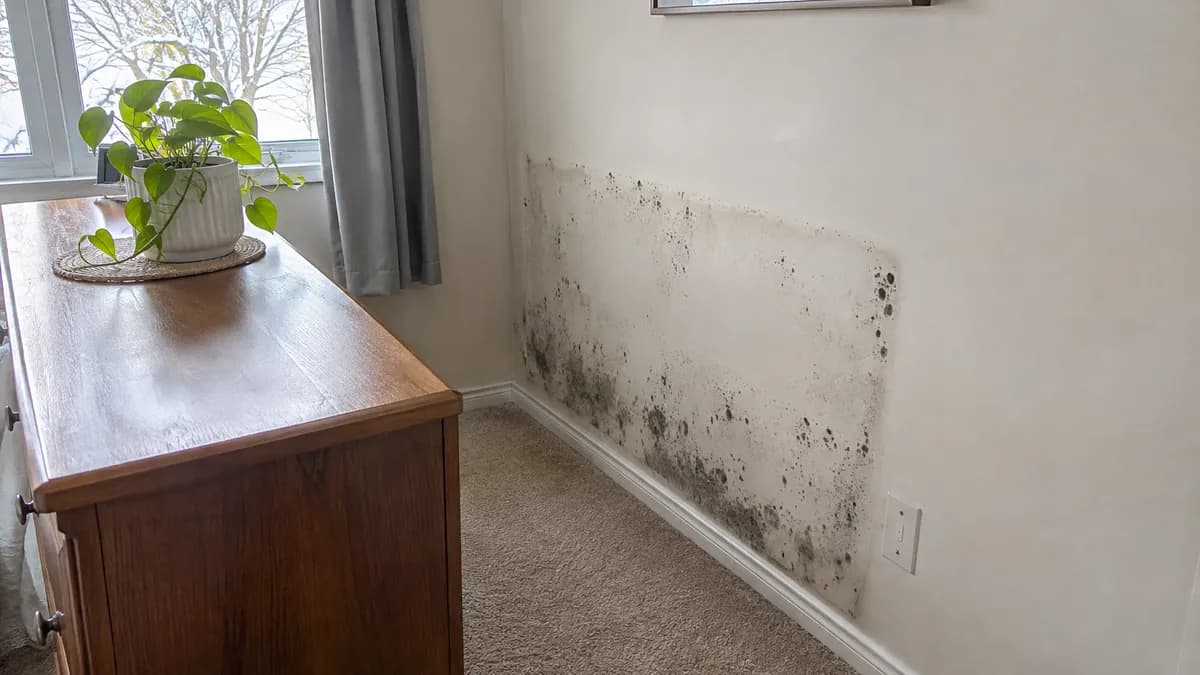
Mould on walls is one of the most common things GTA homeowners and tenants call us about once the weather turns cold. It tends to show up in the same places every winter: the top corner of a bedroom, the wall behind a bed or dresser, the back of a closet, and bathroom walls and ceilings. It usually starts as a scatter of small black or grey dots and spreads slowly from there.
The spots are the symptom. Mould only grows where a surface stays damp, so a wall with mould on it is telling you one of two things: water is getting into it from a leak, or the wall is cold enough for moisture in the air to condense on it. Cleaning the spots without fixing that is why the same patch comes back every year.
This guide covers why mould grows on walls, how to tell it apart from dirt and dust marks, how to clean a small patch safely, and the point where it becomes a job for professional mould removal.
Why mould grows on walls in winter
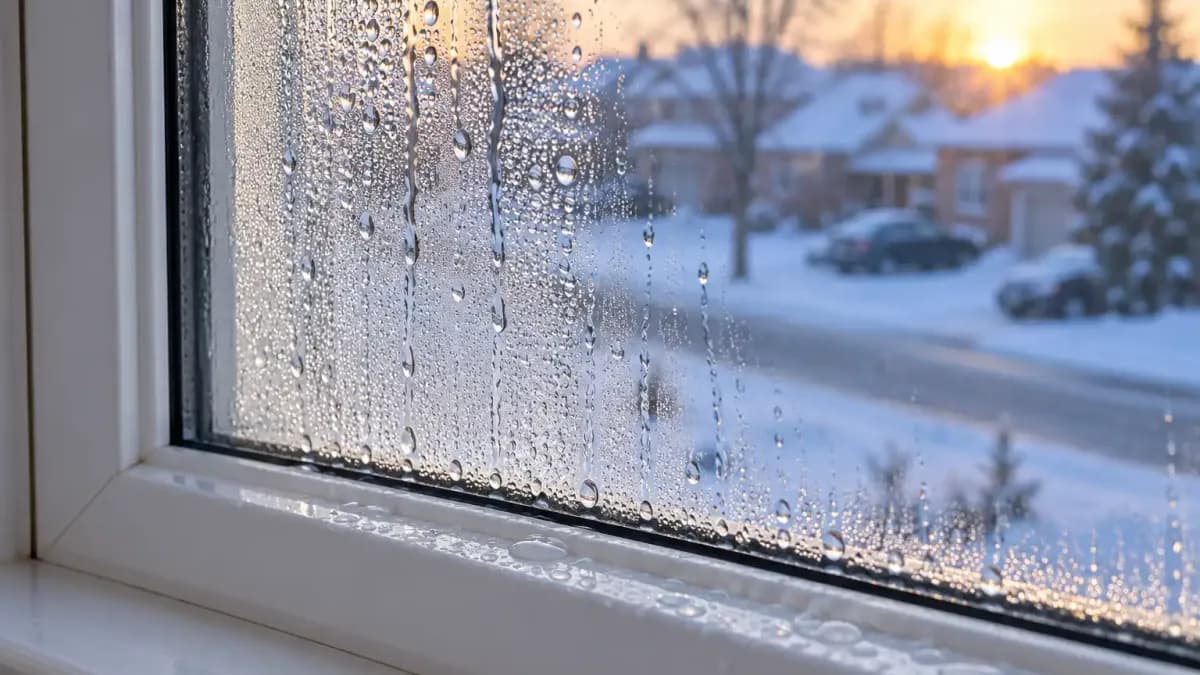
Warm indoor air carries moisture from showers, cooking, laundry, plants and simply breathing. When that air touches a surface colder than its dew point, the moisture condenses into a thin film of water, the same way a cold glass sweats in summer. On a window you can see the droplets. On a painted wall you usually cannot, but the surface stays damp enough for mould to grow on the paint, on the paper facing of the drywall and on the dust that settles on both.
Exterior walls run coldest in a few predictable places:
- Corners, where two exterior walls meet and there is more cold outside surface than warm inside surface.
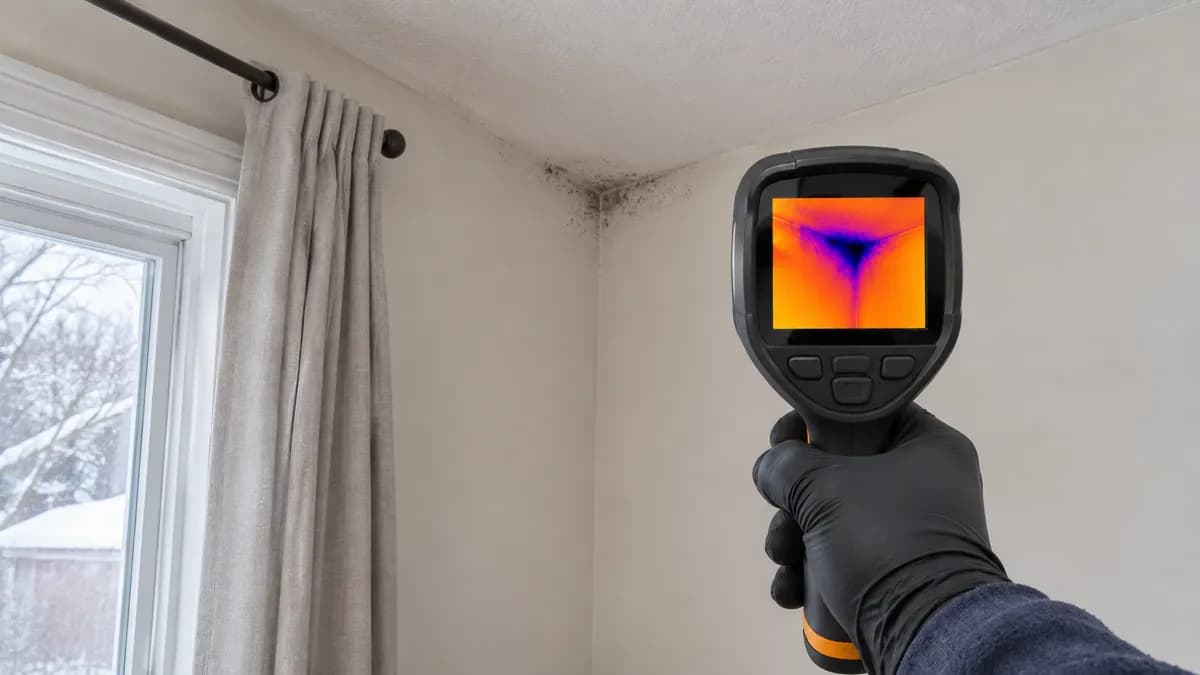
- The line where an exterior wall meets the ceiling on the top floor, especially where attic insulation is thin or has been pushed back at the eaves.
- Along studs, headers and other framing, which carry cold through the insulation. Faint vertical stripes on a wall are often this.
- Behind beds, dressers, couches and heavy curtains, which stop warm room air from reaching the wall.
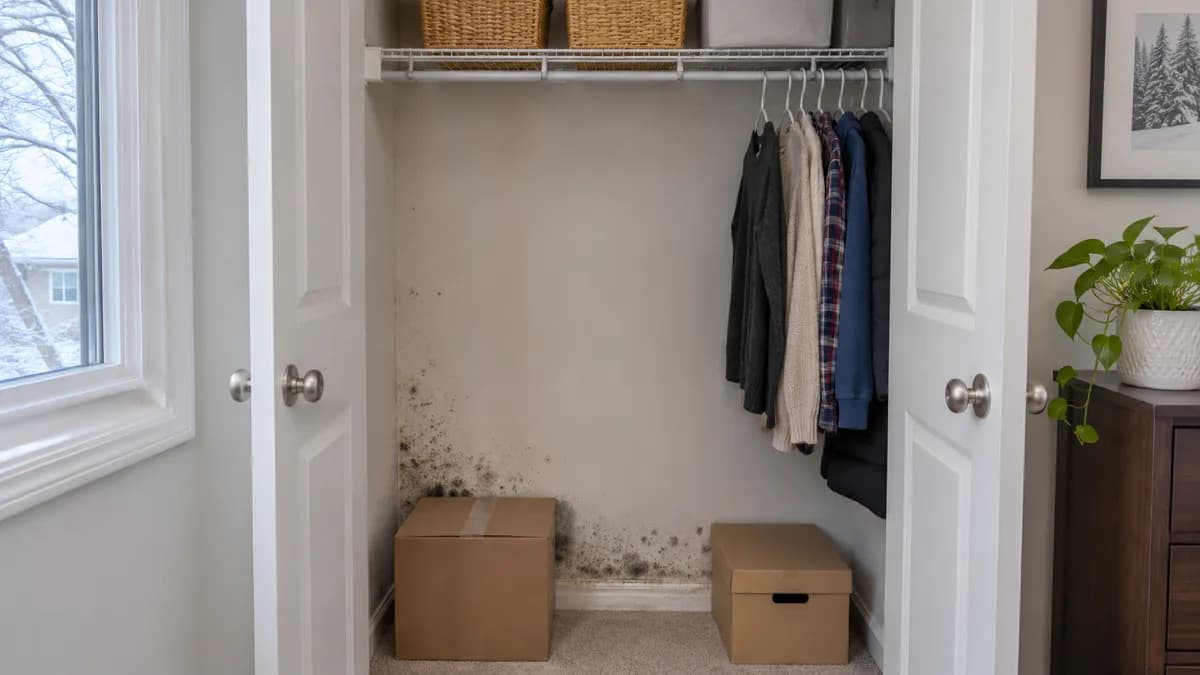
- Inside closets on exterior walls, where the door stays shut and clothes and boxes are packed against the back wall.
- Older Toronto homes with little or no insulation in the walls, and rooms above garages or unheated porches.
Where mould on walls shows up, and what it tells you
Where the mould is usually tells you why it is there. Use this table as a starting point.
If the mould is mainly around windows, our guide to condensation on the inside of windows covers that case in detail, including the maximum indoor humidity for each outdoor temperature.
| Where you see it | Most likely cause | What to check |
|---|---|---|
| Top corner of an exterior wall, or along the ceiling line | Condensation on a cold spot, often from thin attic insulation at the eaves | Indoor humidity, attic insulation and ventilation |
| Behind a bed, dresser, couch or bookcase | Furniture blocking warm air from a cold exterior wall | The gap behind the furniture and the humidity in the room |
| Back wall of a closet | Cold exterior wall with no air movement | Whether the door stays shut, how tightly the closet is packed, humidity |
| Bathroom walls and ceiling | Shower moisture that is not being exhausted | That the fan works, vents outside and runs long enough |
| Low on the wall or along the baseboard | A leak, seepage, a past flood, or water wicking up from the floor | Moisture readings at the base of the wall and any plumbing nearby |
| A spreading stain with mould on it | A plumbing leak inside or above the wall | Fixtures and pipes behind or above the stain |
Mould, dirt or ghosting? How to tell
Not every dark mark on a wall is mould. The two common lookalikes are ordinary dirt and what painters call ghosting: grey shadows or stripes that follow the studs, ceiling joists or the edge of the ceiling. Ghosting happens when dust and soot from candles, fireplaces or cooking settle more heavily on the colder strips of a wall. It points to the same cold spots that grow mould, but it is not growth itself.
A few quick checks will usually tell you which one you have:
- 1Look closely. Mould usually appears as clusters of small dots or fuzzy spots with an irregular, spreading edge. Dirt and ghosting are flatter and more even, and ghosting often runs in straight lines.
- 2Smell the area up close. A musty, earthy odour points to mould.
- 3Wipe a small spot with a damp cloth and a little dish detergent. Dirt and soot come off evenly. Mould often leaves a stain behind, or reappears in the same spots within a few weeks.
- 4Feel the wall. If it is noticeably colder or damper than an interior wall, the conditions for mould are there even if it has not started yet.
Is mould on walls dangerous?
Health Canada notes that mould in the home can cause eye, nose and throat irritation, coughing, wheezing and shortness of breath, and can make asthma and allergies worse. Infants and young children, older adults, and people with asthma, allergies, other breathing conditions or a weakened immune system are more likely to be affected.
Mould on a bedroom wall deserves extra attention simply because of the hours spent next to it. A small patch caught early is a quick fix; a wall that has been growing mould behind a bed for several winters is a different job. If anyone in the home has symptoms you think may be linked to mould, speak with a doctor.
How to get rid of mould on walls
Health Canada says you can generally clean small and medium areas of mould yourself. It describes small as one to three patches, each smaller than one square metre, and medium as more than three patches, or patches between one and three square metres. Larger growth, and mould that keeps coming back, should be handled by a professional. Toronto Public Health puts the professional threshold at about four square metres or more.
The surface matters as much as the size. Mould on a hard, sealed surface can be cleaned. Mould that has grown into something porous usually cannot, because the growth is inside the material.
| Surface | Can it be cleaned? | Notes |
|---|---|---|
| Painted drywall, spots on the paint | Usually, if the area is small | Use a well-wrung damp cloth so the drywall does not soak up water |
| Unpainted drywall, or paper facing stained right through | Usually not | Mould grows into the paper. The section normally has to be cut out and replaced |
| Soft, bubbling or crumbling drywall | No | A sign of water inside the wall. It needs to be opened up and dried |
| Plaster in older homes | Often, if the surface is sound | Harder and less porous than drywall, but check for moisture behind it |
| Wallpaper | Rarely | Mould grows behind it and in the paste. Remove it to see the wall underneath |
| Tile and grout | Yes | Mouldy caulking is usually easier to replace than to clean |
Cleaning a small patch, step by step
For a small patch on a painted wall or another hard surface, the process is simple. The care is in keeping the drywall dry and the spores contained.
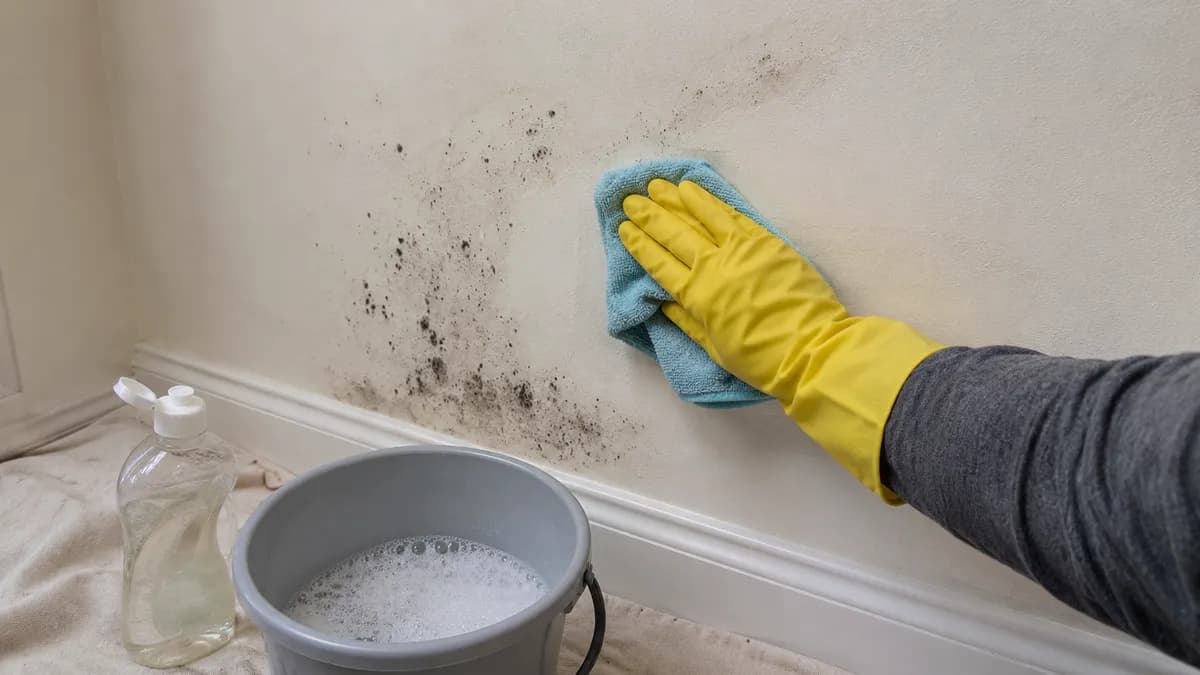
- 1Wear rubber gloves, safety glasses and a dust mask. People with asthma or other breathing conditions should leave the cleanup to someone else.
- 2Close the door to the rest of the house, open a window if you can, and keep children and pets out of the room.
- 3Move furniture away from the wall and lay a drop sheet or old towel along the floor.
- 4Wipe the mould with a cloth dampened in water with a little unscented dish detergent. On drywall, wring the cloth out well so the board does not get wet.
- 5Wipe again with a clean, damp cloth, then dry the area thoroughly with a fan or a dehumidifier.
- 6Bag the cloths and the drop sheet before carrying them through the house.
- 7Fix the moisture problem, then watch the spot for a few weeks. If it comes back, either the cause has not been fixed or the growth goes deeper than the surface.
Can you paint over mould?
Not until it has been cleaned and the wall is dry. Paint, including mould-resistant paint, does not kill growth that is already there. It traps it under the coating, and the spots bleed back through. Once the wall is clean, dry and staying dry, a stain-blocking primer followed by a mould-resistant paint is a sensible finish for bathrooms and problem corners.
When to call a professional
Have the wall assessed if any of these apply:
- The mould covers more than a few small patches, or it is on more than one wall or in more than one room.
- It keeps coming back after you clean it.
- The drywall is stained through, soft, bubbling or crumbling.
- A musty smell stays after cleaning, which often means growth on the back of the drywall.
- The mould appeared after a leak, a flood or a sewer backup.
- It is low on the wall, near plumbing, or on a wall shared with a bathroom or kitchen.
- Someone in the home has asthma, allergies or a weakened immune system, or the home has a baby or an older adult.
What a professional does
A proper assessment starts with the moisture, not the mould. Moisture meters and thermal imaging show how far the wet or cold area extends behind the paint without opening up the wall. Mouldy drywall is removed under containment, with HEPA air filtration so spores do not travel through the house, and the framing behind it is cleaned and dried before anything is rebuilt. Once the wall is confirmed dry, our drywall repair team closes it up and refinishes it.
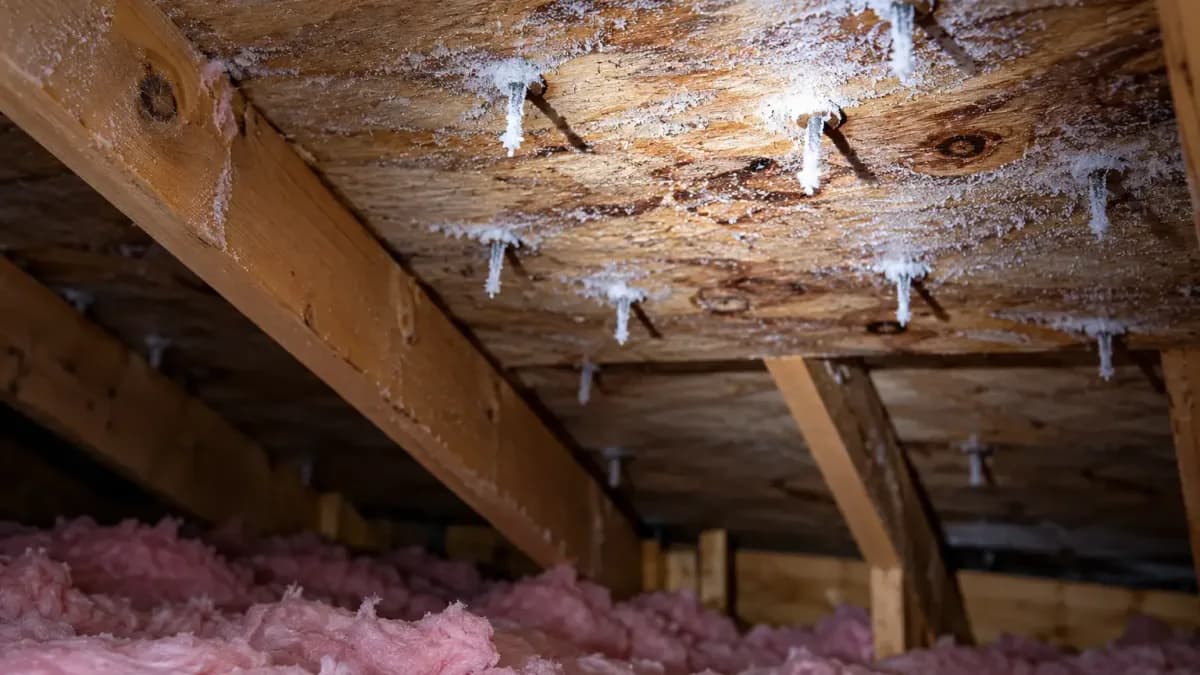
When the problem is a cold top-floor corner, the fix often involves the attic as well: insulation that has slumped or been blown away from the eaves, or soffit vents that are blocked. Our attic mould removal service covers that side, and our guide to frost in the attic explains why it matters in winter.
How to stop mould coming back on your walls
Once the wall is clean and dry, a few habits do most of the work of keeping it that way.
- Keep indoor relative humidity between 30 and 50 percent, as Health Canada recommends, and toward the lower end when it is very cold outside. A digital hygrometer in the problem room tells you where you stand.
- Pull beds, dressers, couches and bookcases at least 5 to 10 centimetres away from exterior walls so warm air can circulate behind them.
- Leave closet doors on exterior walls open overnight, avoid packing those closets tight, and keep boxes off the back wall.
- Run the bathroom fan during every shower and for at least 20 minutes afterwards, and use the range hood whenever you cook.
- Dry laundry in a vented dryer rather than on racks indoors.
- If your home has a heat recovery ventilator (HRV) or energy recovery ventilator (ERV), run it through the winter and keep the filters clean.
- Keep heat registers and radiators clear, and leave interior doors open so heat reaches the coldest rooms.
- Turn down or switch off humidifiers, including a furnace humidifier, if walls or windows are sweating.
- Have the attic insulation at the eaves checked if mould keeps returning along the top-floor ceiling line.
- Dry any leak within 24 to 48 hours. Mould can start growing in that window, as our guide on how long mould takes to grow after water damage explains.
Renting? Mould on walls and your landlord in Ontario
Under Ontario's Residential Tenancies Act, landlords are responsible for keeping a rental unit in a good state of repair and fit to live in, which includes fixing leaks and building problems that cause mould. Tenants are responsible for ordinary cleanliness, so everyday habits like running the bathroom fan and not blocking cold walls matter too.
If you rent, report mould to your landlord or property manager in writing, with photos and the date you first noticed it, and ask what they plan to do about the cause. If nothing happens, Toronto tenants can call 311 to request a property standards inspection, and tenants anywhere in Ontario can apply to the Landlord and Tenant Board about maintenance problems.
Does insurance cover mould on walls?
Usually not when the mould comes from condensation, humidity or a slow, long-term leak, which most home insurance policies treat as maintenance issues. Mould that results directly from a sudden, insured water event, such as a burst pipe, may be considered as part of that claim. Policies vary, so check your wording and speak with your broker. Our guide to whether home insurance covers water damage in Ontario explains how insurers usually draw the line.
Mould on your walls that will not stay gone?
If the patch is bigger than you are comfortable cleaning, it keeps coming back, or the drywall underneath is stained or soft, it is worth having it looked at before another winter of growth. Rosehill Restoration Services provides mould inspection and removal across Toronto, North York, Scarborough, Etobicoke, Mississauga, Markham and the wider GTA.
For a sense of budget, our guide to how much mould removal costs in Toronto breaks down typical pricing by area size. When you are ready, book a free mould estimate and we will find what is growing, what is causing it and what it will take to fix.
Related Restoration Services
Restoration Crews Near You
We respond 24/7 across the Greater Toronto Area. Find your city:
About the Author
Rosehill Restoration Services
IICRC Certified Firm
Rosehill Restoration Services is an IICRC Certified Firm handling water, fire, mould, asbestos, and storm damage across the Greater Toronto Area. Our lead technicians carry Water Damage Restoration (WRT), Applied Structural Drying (ASD), and Fire & Smoke Restoration (FSRT) certifications, and every article here is written from live job experience across GTA properties.
- IICRC Certified Firm
- IHSA COR Certified
- WSIB Ontario Covered
- EACO Member